
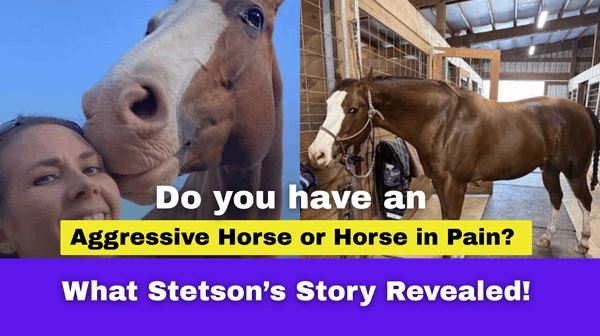
Aggressive horse behavior is often treated like a training problem.
Pinned ears. Biting. Kicking. Sensitivity to touch. Explosive reactions.
But during a recent Holistic Horseworks live session, April Love and horse owner Tia shared a very different perspective.
Sometimes the horse is not being “bad.”
Sometimes the horse is in pain.
The live session focused on Stetson, a horse who had become extremely reactive and difficult to handle before Tia began following the Holistic Horseworks program.
When Horses Become Reactive and Defensive
During the Q&A section of the live session, a viewer described a young horse who:
- Did not want to be touched
- Pinned ears constantly
- Swished the tail aggressively
- Attempted to bite and kick
- Became reactive during bodywork
April immediately connected those symptoms to Stetson’s story.
“That was exactly the Tia horse,” she explained.
According to April, many horses displaying aggressive behavior may actually be experiencing significant physical discomfort, nervous system stress, hoof pain, viral burden, or chronic body tension.
Watch the live session here:
Embed code:
<div class=”substack-post-embed”><p lang=”en”>Aggressive Horse or Horse in Pain? What Stetson’s Story Revealed by April Love</p><p>Do you have an aggressive Horse or Horse in Pain?</p><a data-post-link href=”https://holistichorseworks.substack.com/p/aggressive-horse-or-horse-in-pain”>Read on Substack</a></div><script async src=”https://substack.com/embedjs/embed.js” charset=”utf-8″></script>
Click here to join the next free live session in June
The Symptoms Tia Was Seeing in Stetson
Before beginning the program, Tia had already completed:
- The Holistic Horseworks home study program
- An eight-page distance reading report
- Initial holistic support protocols
During the session, April explained that Tia had been actively working through the recommended steps before appearing live on the show. fileciteturn10file17L50-L57
The goal of the session was not simply to “fix behavior.”
The goal was to understand what Stetson’s body was communicating.
Why Holistic Horse Care Looks Beyond Symptoms
One of the core teachings inside Holistic Horseworks is that symptoms are often signals.
Instead of suppressing the reaction, the work focuses on identifying:
- Nervous system overload
- Pain patterns
- Cranial compression
- Hoof imbalance
- Digestive stress
- Viral burden
- Musculoskeletal tension
- Environmental stressors
According to April, many horses that resist bodywork or react aggressively are physically overwhelmed.
“So there’s really not feeling so good in their body that they don’t want bodywork,” she explained during the session
That shift in perspective changes how many owners approach rehabilitation.
The Holistic Horseworks Starting Point for Sensitive Horses
When horses become too reactive or painful for direct bodywork, Holistic Horseworks often begins with gentler support methods first.
April explained that horses like Stetson frequently start with:
- Craniosacral support
- Hot oil spine treatments
- Hoof support and hoof soaps
- Distance readings
- Nervous system calming
- Nutritional balancing
- Digestive support
“We usually start with cranial sacral, hot oil spine treatment, treating the hooves, and then getting into the body,” April shared.
This approach helps reduce stress inside the horse’s system before introducing deeper bodywork.
The Connection Between Horse Health and Behavior
One of the most important conversations from the Stetson session was the relationship between physical discomfort and horse behavior.
Many horse owners spend months or years trying to train away symptoms that may actually be rooted in:
- Chronic soreness
- Poor hoof health
- Inflammation
- Nervous system stress
- Digestive imbalance
- Viral stress
- Structural compensation patterns
When the horse finally begins feeling safer and more comfortable physically, behavior often changes naturally.
That does not mean training is unimportant.
It means the horse’s body may need support before the horse can fully participate mentally and emotionally.
Looking at the Whole Horse
Holistic Horseworks encourages horse owners to evaluate the entire picture instead of isolating one symptom.
That includes:
- Environment
- Water quality
- Nutrition
- Stress load
- Hoof condition
- Saddle fit
- Cranial tension
- Body pain patterns
- Emotional stress
During the session, April also discussed how viral stress patterns and environmental factors may affect sensitive horses and potentially contribute to chronic health issues.
For owners dealing with horses that seem reactive, shut down, explosive, or resistant, Stetson’s story offers an important reminder:
Behavior is communication.
Learn More About Holistic Horseworks
Holistic Horseworks provides educational resources for horse owners looking to better understand:
- Horse body pain
- Holistic horse health
- Equine craniosacral therapy
- Horse behavior and nervous system stress
- Distance readings
- Natural horse wellness support
- Equine bodywork education
The Holistic Horseworks Remedies App, online courses, and educational programs are designed to help owners recognize early signs of imbalance before they become bigger problems.
If your horse is showing behavioral changes, sensitivity, resistance, or chronic soreness, it may be time to look deeper into what the body is trying to communicate.
Tags: Aggressive horse behavior, horse body pain, holistic horse care, horse behavior problems, craniosacral therapy for horses, horse bodywork, horse nervous system support, sore horse treatment, equine wellness, EPM symptoms in horses, horse rehabilitation, holistic horse healing
Excerpt:
Pinned ears, biting, kicking, and explosive reactions are often labeled as behavior problems, but what if the horse is actually in pain? In this Holistic Horseworks session, April Love and Tia discuss Stetson’s transformation and why nervous system stress, hoof pain, and physical discomfort may be driving behavior many horse owners misunderstand.